|
 Shipley windmill is the youngest and the largest windmill in Sussex. Shipley windmill is the youngest and the largest windmill in Sussex.
She - for windmills are always female - has been known at different times as Shipley Mill, King's Mill, Vincent's Mill and Belloc's Mill. She was built in 1879 for Mr. Fred Marten by Mr. Grist, millwright of Horsham, a firm that had its premises on the corner of London Road and Springfield Road.
It is interesting to note that the estimated cost of building the Mill was �800, although she actually cost �2,500.
Marten and his wife ran the Mill and the village stores and post office at Kings Land house until he died in 1884. After his death his widow Sarah put the house, shop and the Mill up for auction, but it was not sold, and she continued to run it, with Robert Wood as miller, until it was finally sold in 1895 to Richard Vincent.
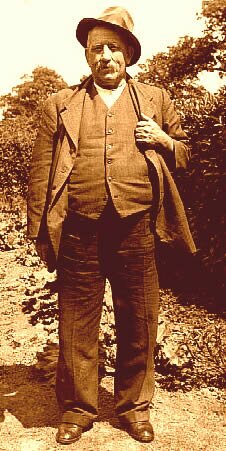
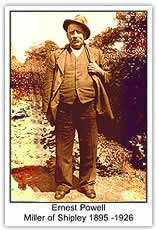
Vincent took on Ernest Powell to work for him as miller. In 1906 Kings Land, the mill and five acres of surrounding land were bought by writer Hilaire Belloc, who then leased the mill to Powell.
Powell continued to operate the Mill until the end of her active life in 1926. During the time she was in active work there were seven or eight other windmills within easy reach. These included Coolham, Cripplegate, Littleworth and West Chiltington. 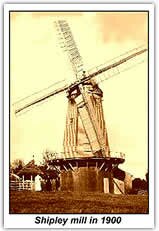
The number of mills was no doubt due to the dependence on them by local farmers, and the limited range of the horse-drawn wagons used to deliver the corn and to collect the meal after grinding.
It is sometimes asked why windmills with their free power should have declined so rapidly in this country. There are probably several reasons. The introduction of motor vehicles allowed farmers to travel further afield, giving rise to bigger power-driven mills. The spread of small internal combustion engines later allowed them to do their own grinding reliably and economically. The increase in wages, too, made it difficult for millers to make their businesses pay without auxiliary power for the days when the wind did not blow.
This last problem did not, however, apply to Shipley Mill. In the shed alongside the Mill there stood a steam engine which, when in action, drove a belt connected to the Mill, so she could work on the days when there was no wind. Indeed, through the years from its construction until the end of the 1914-1918 war, Shipley Mill was always busy, and Mr. Powell was an active and experienced miller.
It was not until the war was over that custom began to slacken off. The renewed import of grain from overseas, leading to the expansion of the big roller mills, better provision of long-distance transport and the spread of electrically driven machinery, caused the windmills of the country to become less popular. Shipley Mill was no exception, in spite of Ernest Powell's efforts. By 1922 she had ceased regular working, and, although she operated spasmodically until 1926, her active life was over.
Between the two wars Mr. Belloc was at pains to preserve the fabric of the Mill, but when the Second World War came and for some years after it, no materials were available to keep her in repair. At the time of his death in 1953 much needed to be done to prevent the Mill from falling into ruin like many others throughout the country.
Following local initiatives, an appeal was launched to restore Shipley Mill as a memorial to Belloc. His many friends and admirers responded generously, and a local committee was formed, including Ernest Powell's son, Peter, who from his boyhood had loved the Mill and helped to work her. The committee also gained the support of the West Sussex County Council, who agreed to contribute towards the repairs and maintenance of the Mill, with the help of the admission charges paid by visitors. The repairs were carried out by the well-known firm of Sussex millwrights, Ernest Hole & Sons of Burgess Hill. On completion of the work, a memorial plaque designed by Edmond Warre, an old friend of Belloc's, was fitted above the entrance door to the Mill, and a grand opening was held in May 1958.
The local committee, the Friends of Shipley Windmill, continued to open the Mill regularly to visitors each summer, and to operate her whenever possible until 1986, when it became clear that further major repairs would be necessary if the Mill was to continue to turn.
The County Council, realising that it would find it difficult to continue to cover these costs, then agreed to set up a charitable trust to manage the Mill, in conjunction with the owner and other interested parties.
Accordingly, the Shipley Windmill Charitable Trust was formed in 1987, and still manages the Mill. The trustees today include representatives of the County and the Horsham District Councils, the Friends of Shipley Windmill, the Mills Section of the Society for the
Protection of Ancient Buildings and the Sussex Literary Guild, to represent the literary interest, together with the present owner of the mill, Charles Eustace, great grandson of Belloc. Charles Eustace gave the Trust a 25-year lease of the mill at a peppercorn rent.
The first priority of the Trustees was to have a survey to see the extent of the repairs needed to restore the mill to full working order, and to raise the necessary money. They engaged a professional millwright, Vincent Pargeter, to carry this out. His report revealed that the necessary works were more extensive than had been envisaged, and, in 1987, would cost in the region of �160,000. However, thanks to substantial donations from the County Council and from Horsham District Council, together with a 40% grant from English Heritage, plus other generous donations both from individuals and grant-giving trusts, it proved possible to make an early start on the necessary works. After tenders had been received from several firms of millwrights, the local firm of Hole and Son was again engaged to carry out the work. The Mill was re-opened, although with only a single pair of sweeps, in July 1990, by the Lord Lieutenant of West Sussex. A year later, further grants and donations made it possible to complete the second pair of sweeps, and in May 1991, Shipley Mill was once again working in all her glory.
In 2000, English Heritage gave another grant towards the restoration of the engine shed which is attached to the Mill, and by the end of that year the fabric of the building was completed. The new visitor centre was opened in the northern end in time for the 2001 season. The other end of the building now houses an engine, which is at present being installed to drive the mill when wind is in short supply.
|


 S h i p l e y W i n d m i l l