|
Shipley mill has five floors. In order to see how she works, it is best to start at the top and work your way downwards. Climb up four flights, and you will reach the top of the Mill to start your tour.
The Bin Floor
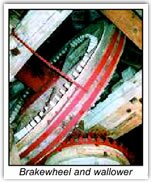 The top floor of the smock tower is known as the bin floor, as around the floor are the bins into which the sacks of grain can be tipped, so that it can be fed into the millstones below. Above your head, you can see the cap, and the curb round which it slides to bring the sails into the wind. In the cap is the cast iron windshaft on which the sweeps turn. Mounted on the windshaft is the huge wooden gear known as the brakewheel, so called because round its rim is the wooden brake which is used to stop the mill. The brake is operated by the long iron brake lever, which can be raised by pulling the brake rope from the stage at the second floor level. The top floor of the smock tower is known as the bin floor, as around the floor are the bins into which the sacks of grain can be tipped, so that it can be fed into the millstones below. Above your head, you can see the cap, and the curb round which it slides to bring the sails into the wind. In the cap is the cast iron windshaft on which the sweeps turn. Mounted on the windshaft is the huge wooden gear known as the brakewheel, so called because round its rim is the wooden brake which is used to stop the mill. The brake is operated by the long iron brake lever, which can be raised by pulling the brake rope from the stage at the second floor level.
The brake wheel is fitted with wooden cogs made of hornbeam, each one individually mortised into the rim of the wheel. These cogs mesh with a horizontal iron gear, known as the wallower. Most of the gearing in the mill is wood against iron, which is why the Mill is so quiet in operation that you will not hear her turning. The brakewheel cogs were renewed in 1990, as the old ones were showing signs of wear. The wallower is mounted on the top of the upright shaft, which is a 20ft long piece of oak, extending through the floor to drive the machinery below.
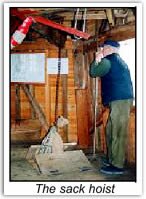 The Sack Hoist The Sack Hoist
Also on the bin floor is the mechanism for operating the sack hoist, which is used for bringing sacks of grain up to the top of the mill.
Pulling the rope raises the end of the hoist drum until the conical end makes contact with the wooden cone under the wallower. The drum will then start to turn, winding up the hoist chain, and with it the sack of corn which has been fastened to its end.
The sack will push its way through the traps on each floor until it reaches the bin, or dust floor, where the miller can detach it and pour the contents into the appropriate bin.
There are eight bins on this floor - see how many you can find when you visit!
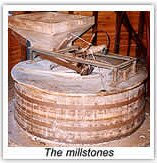 The Stone Floor The Stone Floor
Go down the ladder, and you will reach the stone floor. Here you will see the millstones which do the actual grinding of the corn. There are three pairs of millstones, one of which is opened up so that you can see how it works. Each pair of millstones consists of a bedstone, which is stationary, and a runner stone, which rotates above it. The runner stone is driven from below, through gearing, and the grain is fed into the eye, the hole in its centre, from which it passes outwards, being ground between the faces of the stones. The grinding is done by the flat areas of the stones, which are picked with a series of small furrows or groves. The furrows serve to allow a current of air to pass 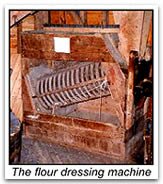 through the stones, to keep the meal cool while it is being ground. The stones weigh up to three-quarters of a ton each, so to lift them up there is the stone crane with its curved iron arms which fit into holes on the sides of the stones. The miller needed to raise the runner stone and turn it over every two to six months to re-cut the furrows in it. This is known as dressing the stones. To prevent the flour from spilling out, the stones are encased in a vat or tun. The bell alarm is fitted onto the vat, to warn the miller if he is running out of grain by ringing when the hopper above the stones is nearly empty. Also on this floor is the flour dresser, which consists of a wire mesh drum, inside which four brushes can rotate, forming a sort of giant rotary sieve, to separate the bran from the meal after it has been ground, producing white flour, semolina & bran. through the stones, to keep the meal cool while it is being ground. The stones weigh up to three-quarters of a ton each, so to lift them up there is the stone crane with its curved iron arms which fit into holes on the sides of the stones. The miller needed to raise the runner stone and turn it over every two to six months to re-cut the furrows in it. This is known as dressing the stones. To prevent the flour from spilling out, the stones are encased in a vat or tun. The bell alarm is fitted onto the vat, to warn the miller if he is running out of grain by ringing when the hopper above the stones is nearly empty. Also on this floor is the flour dresser, which consists of a wire mesh drum, inside which four brushes can rotate, forming a sort of giant rotary sieve, to separate the bran from the meal after it has been ground, producing white flour, semolina & bran.
|


 S h i p l e y W i n d m i l l


