Introduction - Types of Mill
There are three kinds of windmill. The earliest of these is the post mill, which consists of a box-like structure of wood, containing all the machinery. This can be turned into the wind on a central upright post.
Later came the tower mill, which is built of brick or stone, except for the revolving cap on the top; and the smock mill, which is similar to the tower mill, but has wooden tower with six or eight sides, often on a brick base.
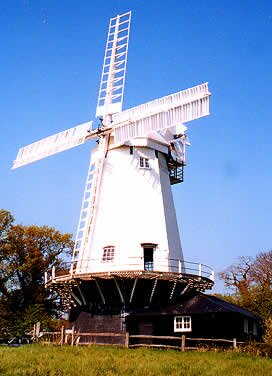
Shipley is an eight-sided smock mill, so-called because she is supposed to look like the old-fashioned farm labourer's smock.
Outside of the Mill
Before you start your visit, go outside and look up at the Mill. You can see that she is built on a brick base, which is two stories high. Above that there are three more stories of wooden tower, tapering towards the top.
On the very top is the cap, perched like a hat on top of the wooden tower. The cap carries the sails, which in this part of the country are always known as sweeps. At the back of the cap is the fantail, another little windmill, set at right angles to the sails. The wind blowing against the sweeps causes them to rotate.
For the Mill to work, it is necessary for the sweeps to be facing directly into the wind. To do this the whole cap must be turned. This is done automatically by the fantail. The fantail turns when the wind blows on it from one side, driving a series of gears, connecting to a worm which in turn mates with a toothed ring on the top of the smock tower, known as the curb. It is on this curb that the cap rests and turns.
The cap has no wheels - it slides on greased iron plates on the top of the curb.
The whole cap, together with the sweeps, fantail and gearing weighs about fourteen tons.
The Sweeps
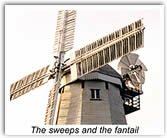 The shuttered sweeps fitted to Shipley Mill are of the type known as Patent Sails. Invented by an engineer called William Cubitt in 1807, their big advantage is that they can be adjusted without the need to stop the Mill. The shuttered sweeps fitted to Shipley Mill are of the type known as Patent Sails. Invented by an engineer called William Cubitt in 1807, their big advantage is that they can be adjusted without the need to stop the Mill.
Each of the four sweeps carries a set of shutters, which can be opened and closed like a Venetian blind, by the movement of the uplongs, long wooden rods to which the shutters are connected. At the centre of the four sweeps, the uplongs are coupled to the spider, which connects through links and triangles to the striking rod, an iron bar that goes right through the windshaft, which carries the sweeps. At the back of the mill the striking rod connects to the chainwheel, from which is hung an endless chain, reaching down to the stage outside the second floor of the Mill. The striking weight is hung on this chain to hold the shutters either open or closed. The speed of the Mill can be regulated to some extent by altering the weight; a heavy weight will hold the shutters tightly closed in a light breeze, while a lighter weight can be used in a strong wind to allow the shutters to open slightly in the gusts. Ten to twelve turns per minute of the sweeps is a good speed for grinding.
Next Page >>
|


 S h i p l e y W i n d m i l l